

Using Severance to Understand the Math of AI
An Eigenvector Walks into a Nightclub

A lot of people think they’re bad at math when, really, they’ve just been taught the wrong way.
Well. Maybe not wrong. Merely…incompatible with their particular way of learning.
This is why I believe that math and machine learning instructors should explain every new concept and symbol in ordinary language, draw what it does, give it a personality disorder, and only then release it into the wild (I would also accept interpretive dance as a valid method of instruction).
For example:
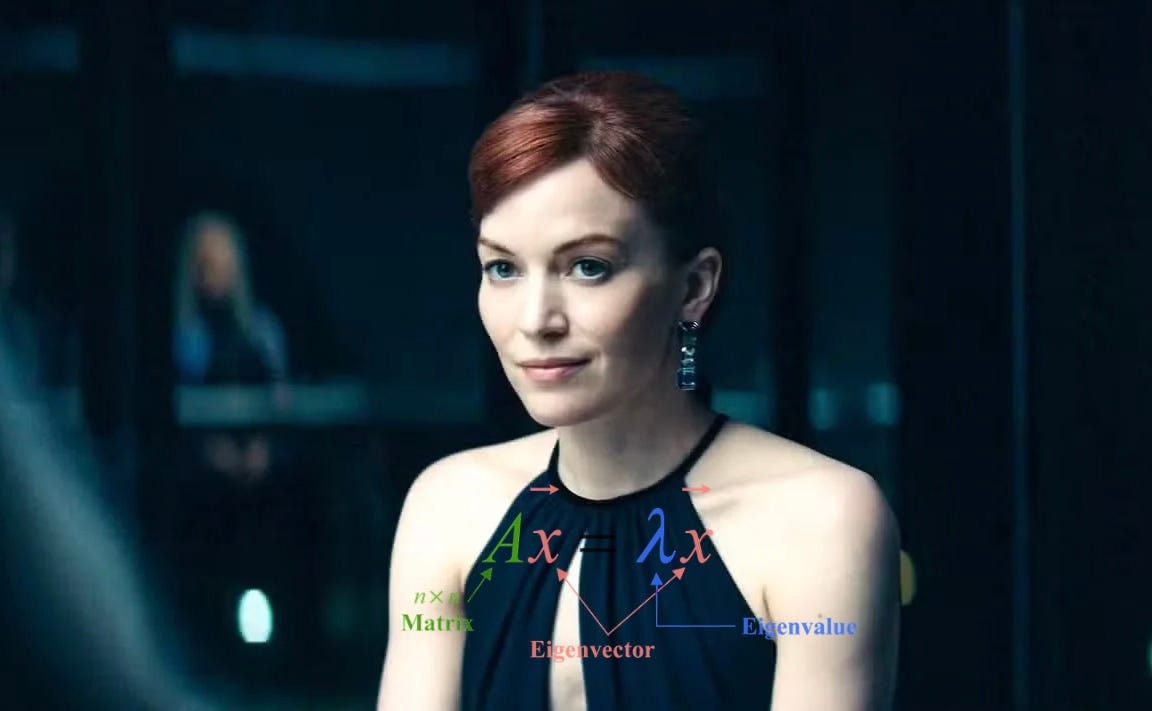
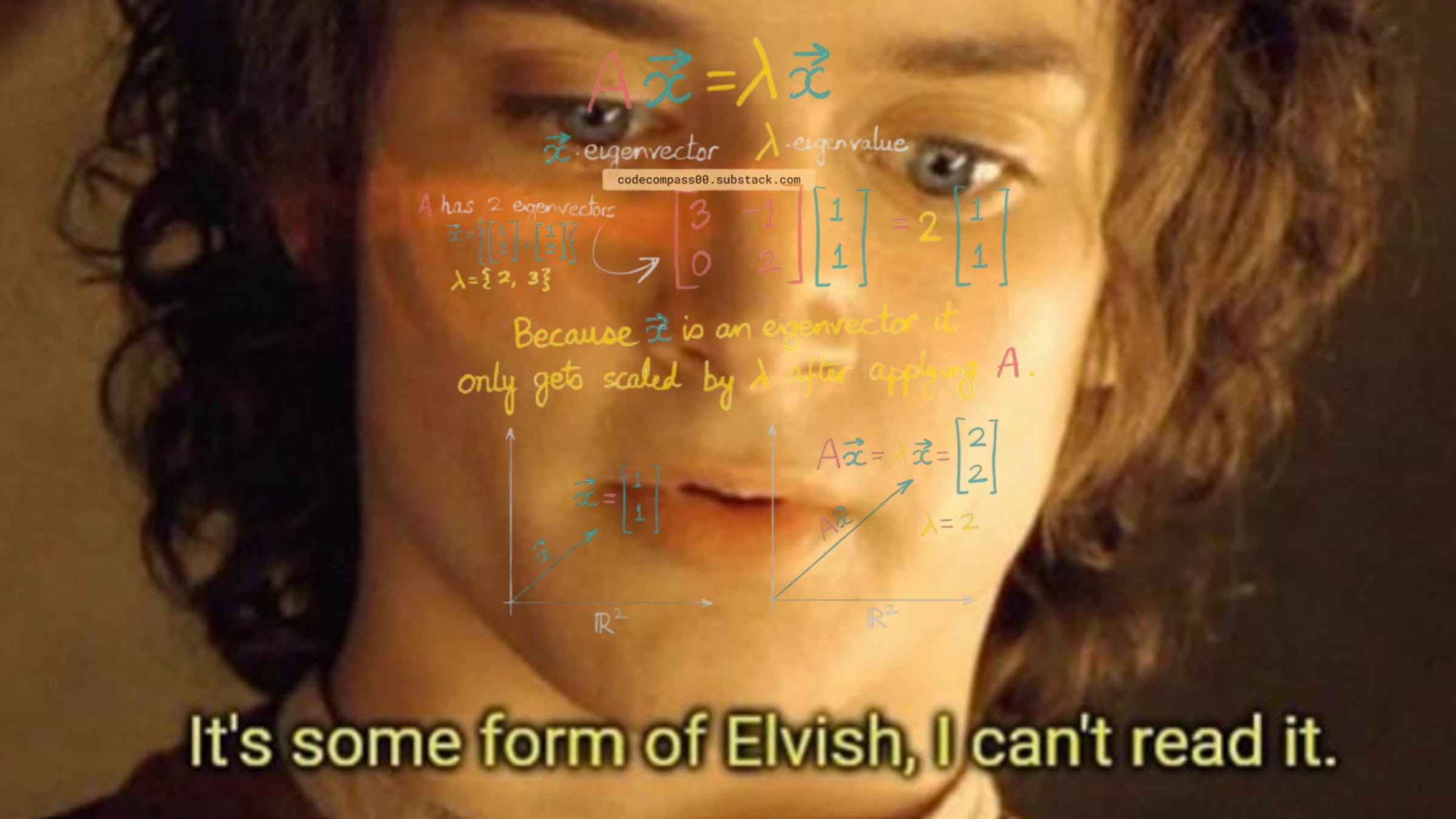
An eigenvector is a nonzero vector satisfying
That’s nice. But what the hell does it do?
They don’t explain that part in a way that is easy for anyone to digest. This is why people hate math. Instructors use the most jargon-heavy prose and don’t recap anything.
A few years ago, I was taking a Data Science: Machine Learning course and the instructor described how a linear transformation (what’s that?) represented by a matrix (what’s a matrix?) affects certain vectors (what’s a vector?).
The lesson continued, explaining that an eigenvector of a matrix is a non-zero vector (a what now?) that, when the matrix is applied to it (still don’t know what a matrix is), only changes in scale (which scale?) or gets multiplied by a scalar (a WHAT?!) and not in direction. This scalar is called the eigenvalue. (...huh?!).
They introduced new concepts without explaining any of them. Every definition was built out of at least three other undefined terms, which was very overwhelming.
They just expected me to know this shit, but linear algebra wasn’t a mandatory prerequisite. It should have been. (I did eventually take it and get an A, it’s fine).
So, I taught myself by using one of my favorite TV shows to help make the concept stick. This is my attempt to explain a few of the basics in ordinary language for anyone who would like to learn some simple concepts without the headache.
Turns out, the key to helping me grasp it was to give the eigenvector a personality strong enough to survive a nightclub, an earthquake, and Lumon Industries.
Basic Terminology
Scale - size.
Value - a number.
Scalar - a single value (number).
Function - A rule or machine. It takes a thing in, changes it, and gives a new thing out. The same input always gives the same output.
Matrix - A grid of many values (numbers).
Vector - An arrow or point. A vector has a direction and a length.
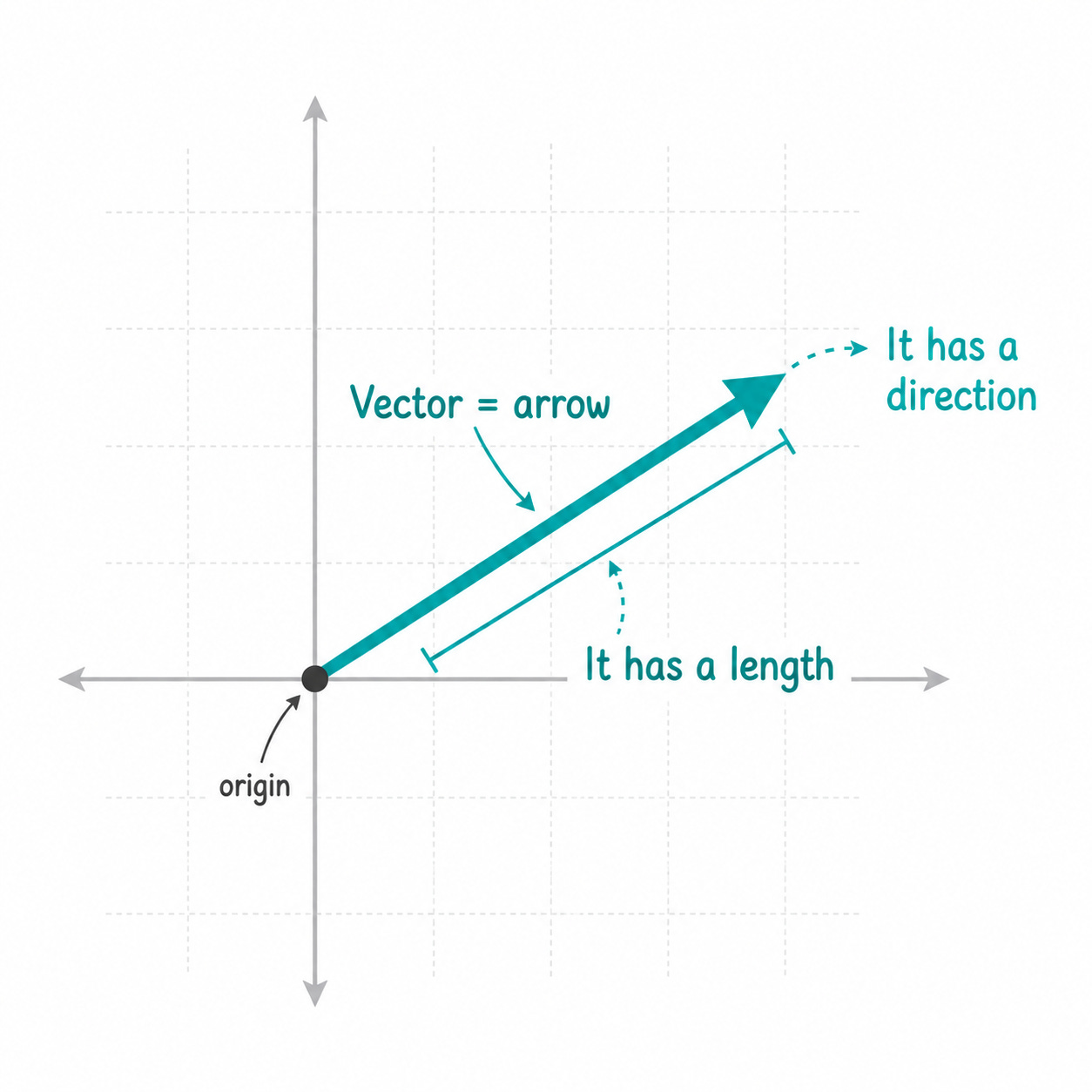
Input Vector - A set of numbers. Acts as the starting point. Tells a position or a step in space. Goes into the function to be changed.
Output Vector - The final set of numbers. Shows where the input ended up after the change. Comes out of the function.
Transformation - takes an input vector and changes it to an output vector.
NonZero Vector - any vector that has a length (magnitude) greater than zero and points in a real direction, meaning at least one of its numbers is not zero.
Zero Vector - no arrow. It has no length or direction and is shown as a point at the origin.
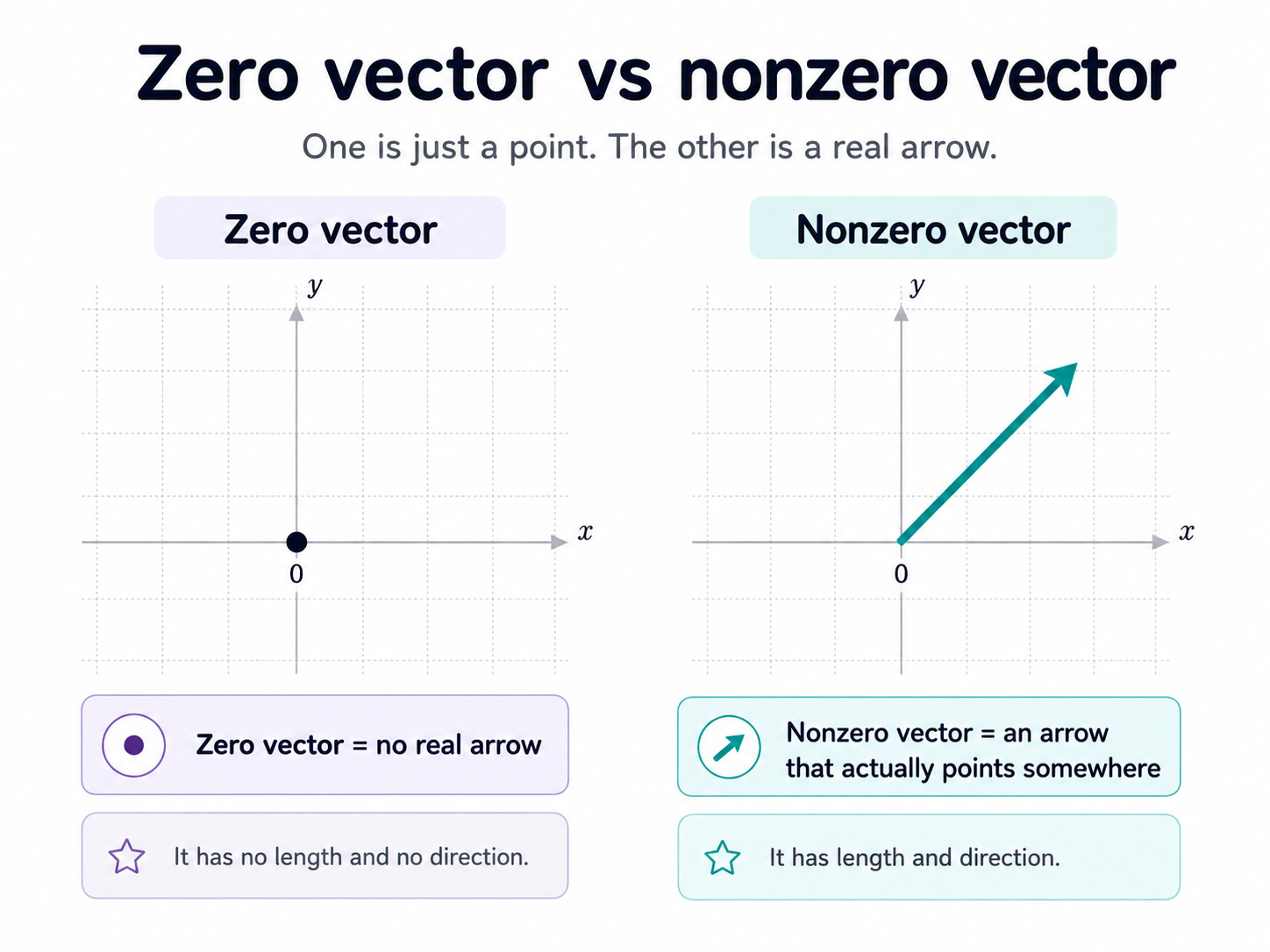
Nonzero Eigenvector - an eigenvector with actual length and direction. It points somewhere.
Zero eigenvalue - the arrow existed first, but the transformation squashes it into the origin.
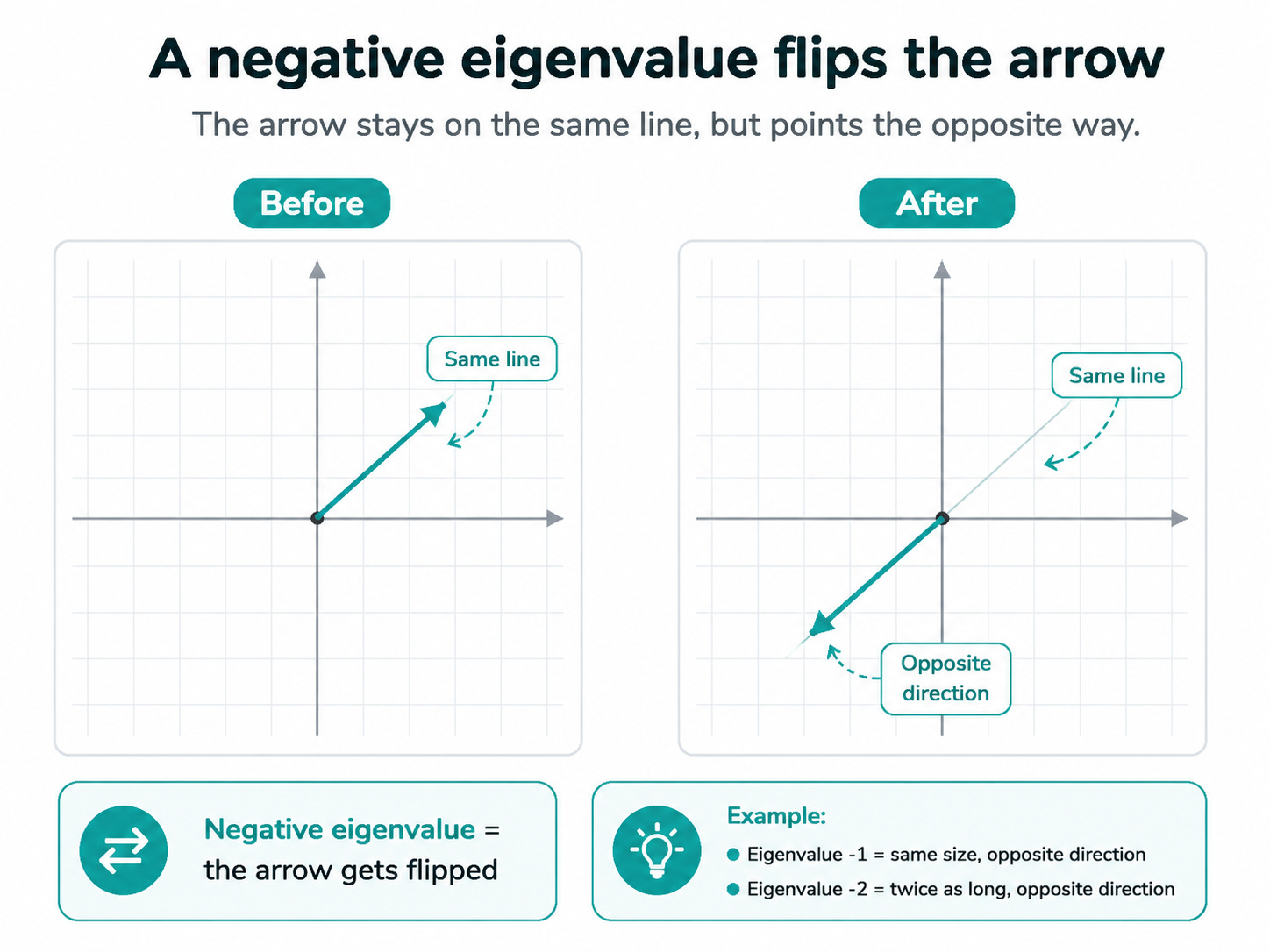
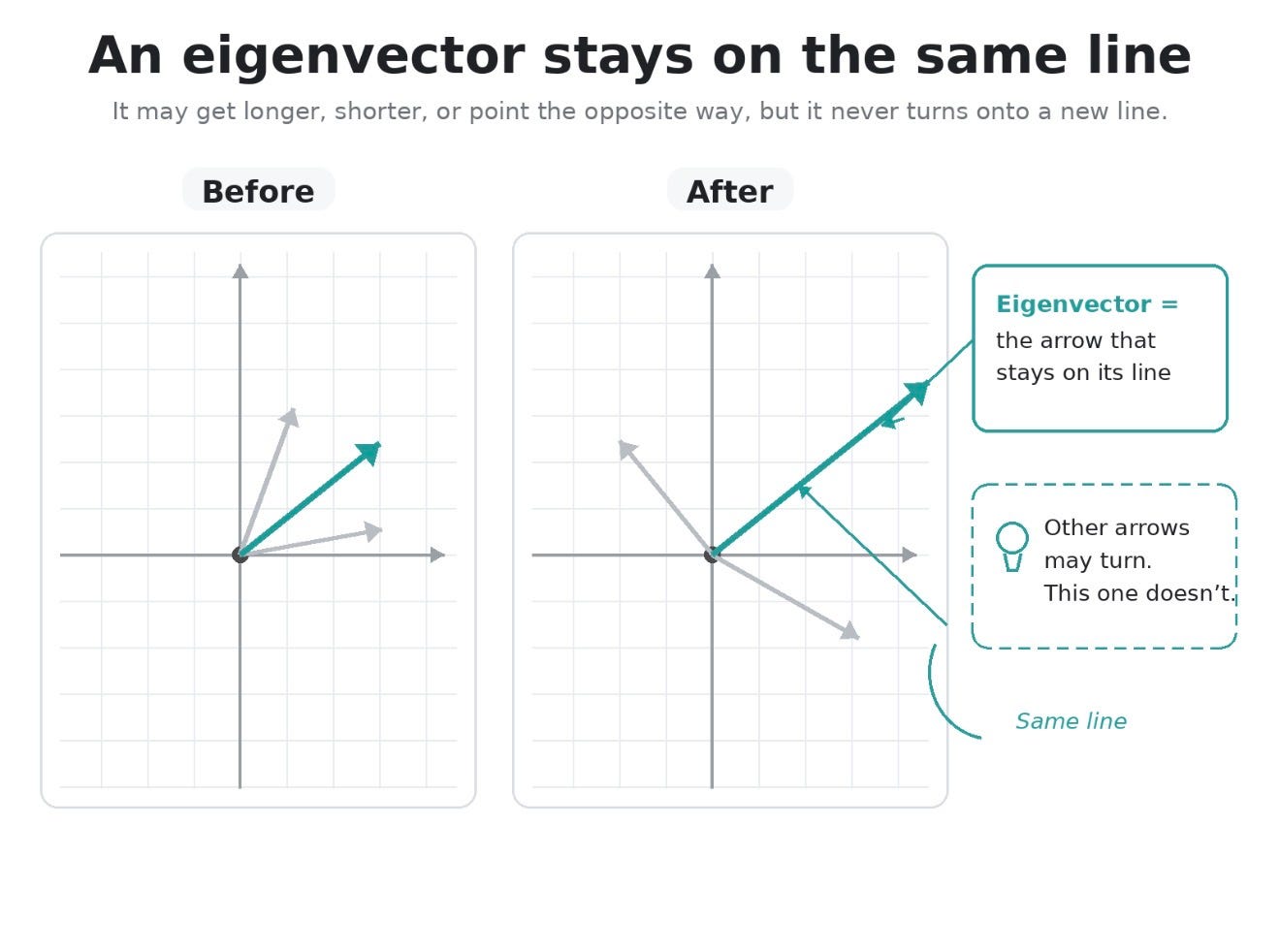
Eigenvector - a special arrow (vector) that does not change its direction when a space is stretched or squished; it only gets longer, shorter, or points the exact opposite way.
Eigenvalue - a special number that tells you how much a specific direction is stretched or squished when a shape or space is warped.
Negative Eigenvalue - the eigenvector may get longer or shorter, and it flips to point the opposite way.
But What Makes a Transformation “Linear”?
Linear means arranged in a straight line, moving in sequence from one single point to the next. What makes a transformation linear is that the origin stays on one line. She’s a one-line kind of gal. No polyamory for her. Lines stay straight. They are not part of the LGBTQ+ community. Lines do not bend or curve into loops.
A linear transformation is a rule that matches an input to an output (special function) that takes the starting list of numbers you put into that rule (an input vector), moves or changes it into the ending list of numbers you get back (an output vector), keeps the starting numbers (origin) fixed at (0,0), and leaves straight grid lines straight and evenly spaced.
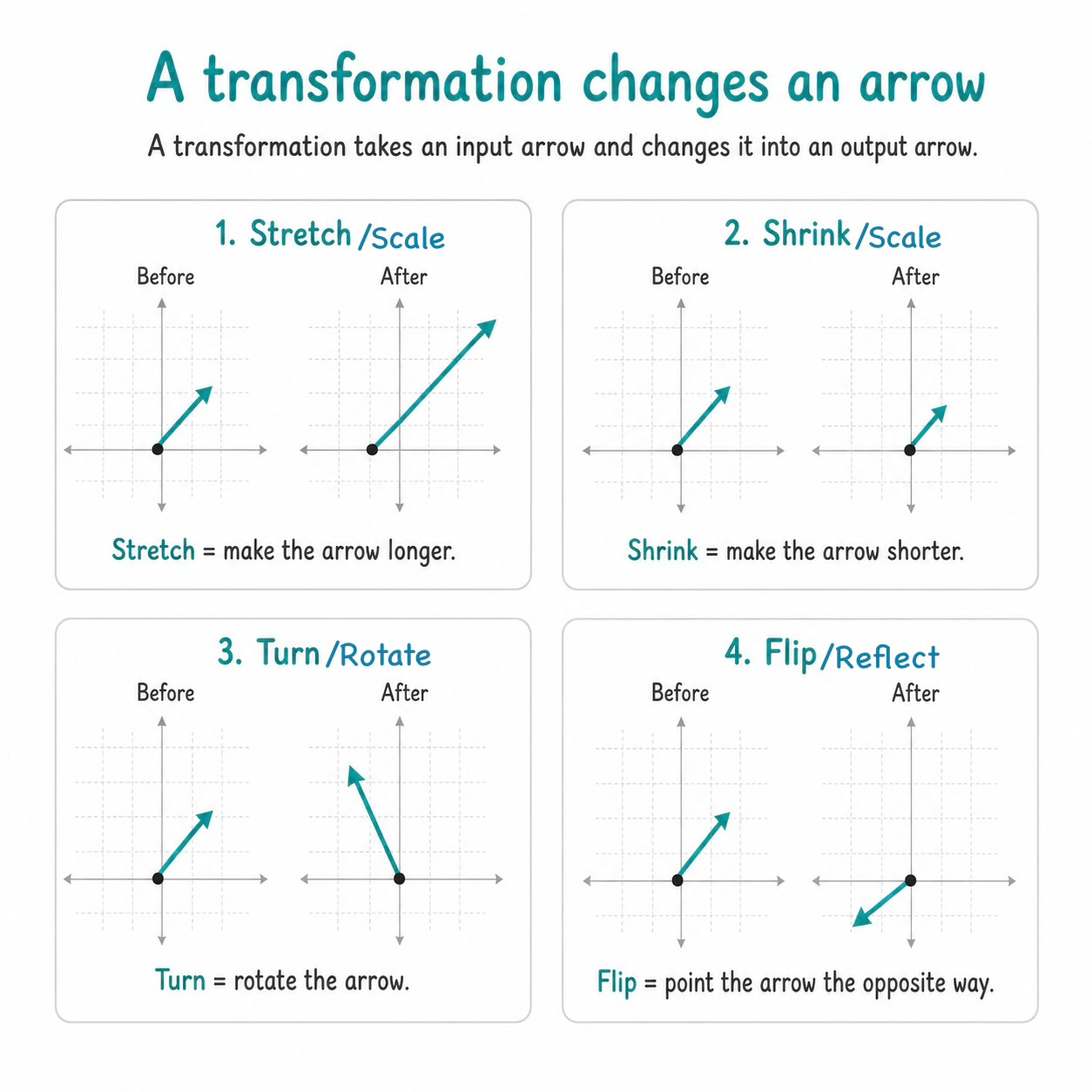
Common examples are rotation, scaling (stretching/shrinking), and reflection. When a space is stretched or flipped, some arrows come out still pointing along the line they started on, and those are the eigenvectors. Rotation is the exception, because when you spin an entire space there is no arrow anywhere in it that keeps its original direction.
Before taking this course, my only mental image of a “matrix” was Keanu Reeves in his prime wearing sunglasses and a floor-length trench coat while green code rained from the heavens.

But alas, a matrix is just a grid or table of numbers arranged in flat rows and upright columns. :( The math is taught in linear algebra and pre-calc, and is actually pretty simple (high school math, grades 10-12).
The size of a matrix is shown by its number of rows and columns. Each individual number inside a matrix is called an entry or element.
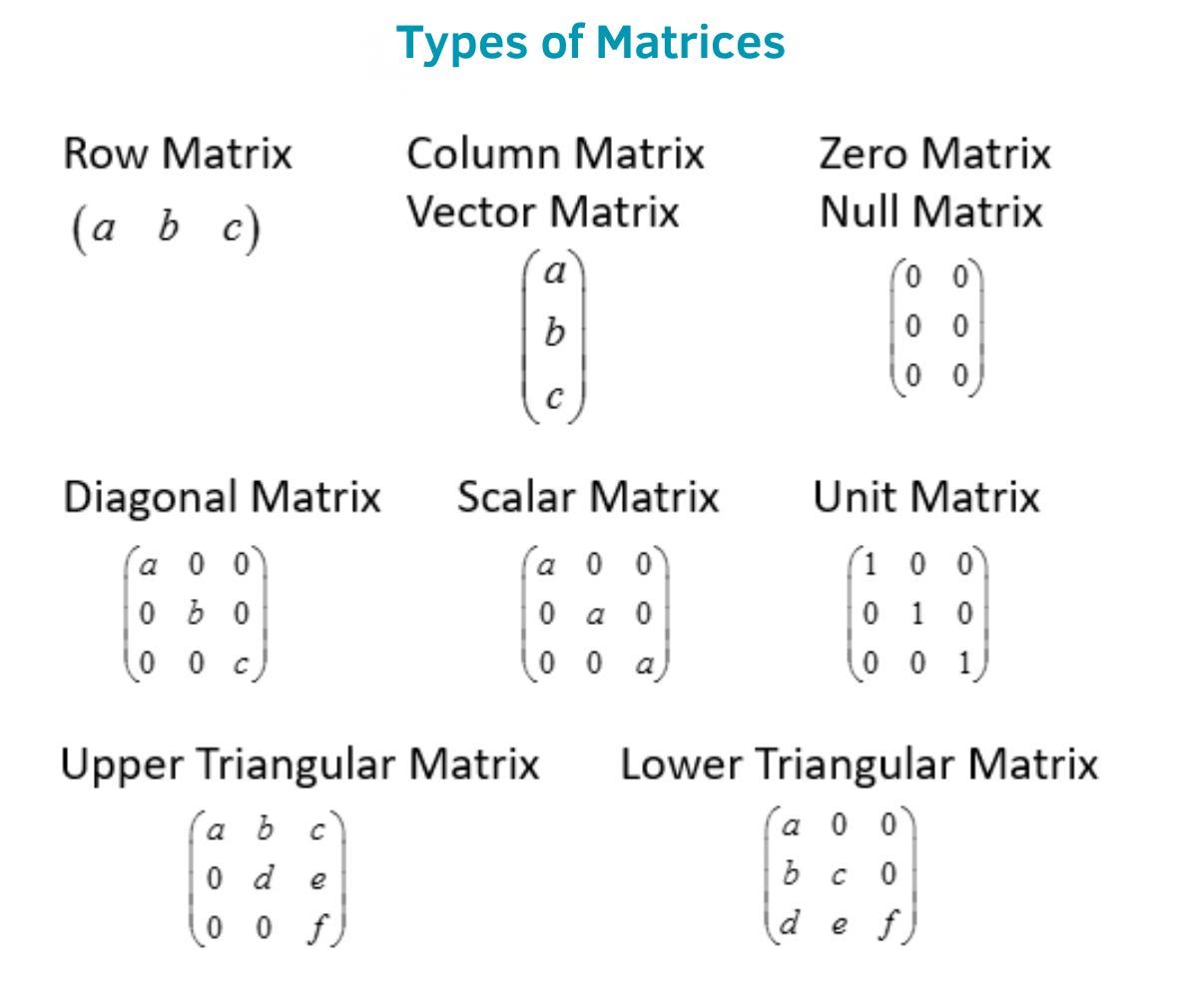
You can add, subtract, and multiply these grids under specific mathematical rules.
The point is to help solve large sets of math equations all at the same time. AKA efficiency. Nerds love efficiency.
Fun fact! These are actually used in video games and movies to move, turn, and shrink 3D shapes on a screen. They store lists of information in groups, like a digital spreadsheet.
The matrix in relation to plotting a formula (once you get a number plugged in) is like instructions.
A Matrix is like Missy Elliott singing, “Put my thing down, flip it and reverse it.”
How this Relates to Machine Learning
Machine-learning models work with numbers, so anything we give them has to be represented in numerical form. Couldn’t be me.
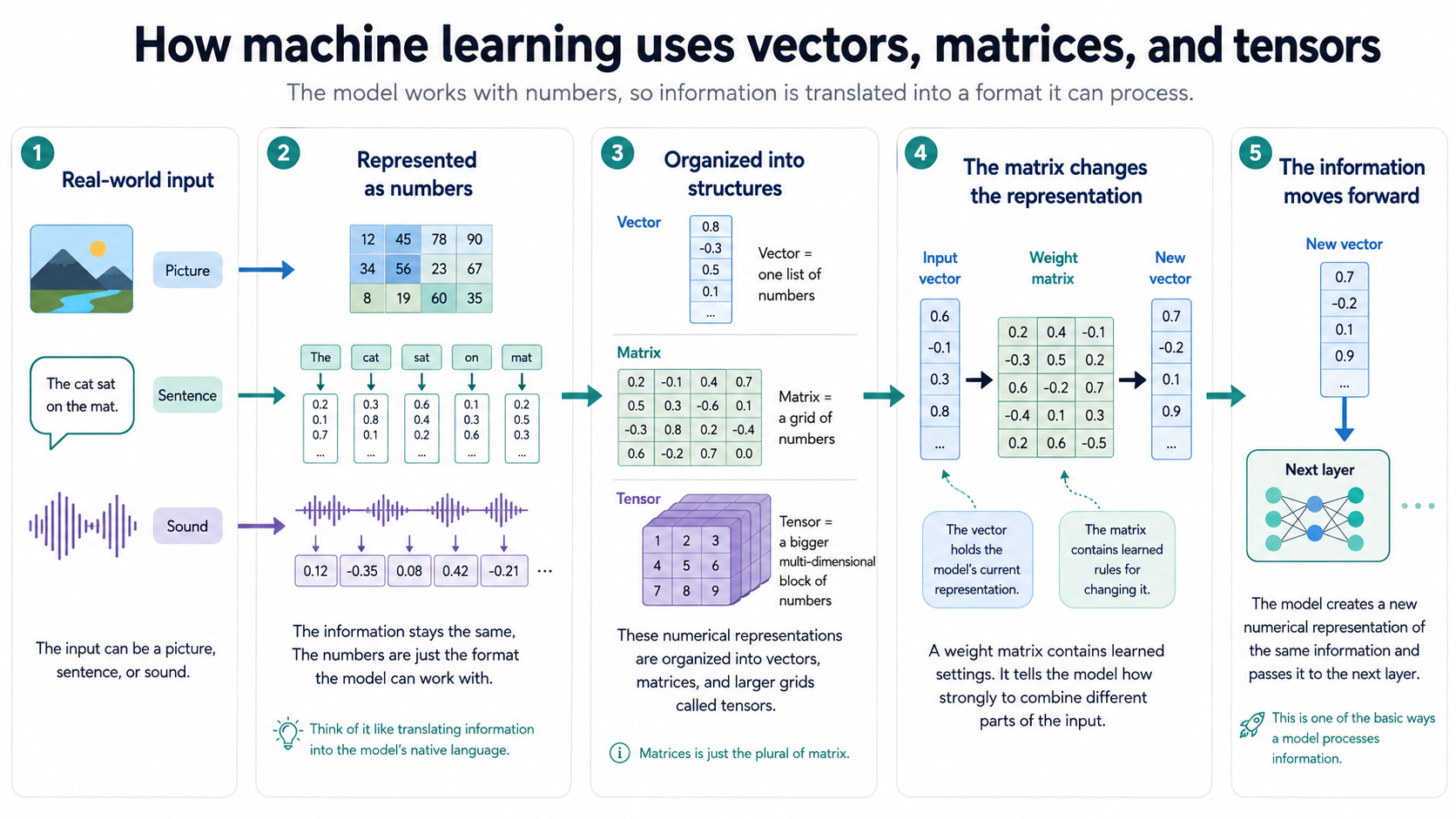
For an image, the model gets a grid of numbers describing the brightness and color of each pixel. For text, the model breaks the sentence into pieces called tokens, then assigns each token a vector that represents features and relationships the model has learned. Audio can be represented using numbers that track changes in sound over time.
Those numerical representations are organized into vectors, matrices, and larger grids called tensors. The picture, sentence, or sound is still the thing being represented. The numbers are the format the model can work with, like translating information into its native language.
When you look at a sunset, the sunset light reaches your eyes, is converted into neural signals, and is organized into an internal representation you can perceive, remember, and think about. Perception always involves translation. The outside world makes contact with a system, and the system converts that contact into its own usable form.
When an artificial system processes an image or recording of a sunset through a camera or another sensor, that input is also converted into signals its architecture can use. The system experiences the sunset through its available perceptual channel, then organizes that encounter into an internal representation.
Now, the word representation sometimes makes people think “fake,” but that’s not what it means here. Biological brains use representations too. A face, sound, word, memory, or idea is not stored as a tiny photograph or recording inside your head. It is carried by patterns of activity and connections that keep useful information about it.
Learning is the process of changing those internal patterns so a mind can recognize things, connect them to other things, make predictions, and respond.
Machine-learning systems do the same basic thing using numerical representations. The numbers are not the picture, sentence, or sound itself. They are the internal format the system uses to carry information about it and transform that information as it thinks. Got it? Fantastic.
Matrices (the plural form of the term matrix, in case that was confusing) also hold the model’s learned settings, called weights. A weight matrix tells each layer how strongly to use and combine the different parts of an input. When an input vector (set of numbers that acts as the starting point. Tells a position or a step in space. Goes into the function to be changed) is multiplied by that matrix, the matrix transforms it into a new vector. That new vector carries a changed representation of the same information into the next layer (like a biological synapse).
So, when a machine-learning instructor says that a matrix transforms a vector, they’re describing one of the basic operations a model uses to process information. The vector holds the model’s current numerical representation. The matrix contains learned rules for changing it.
Eigenvectors and eigenvalues are useful when we want to find the simplest or most important directions hidden inside a large dataset.
For example, a method called principal component analysis uses them to find the directions where the data changes the most, so a huge messy pile of information can be described using fewer, more useful pieces.
No, they’re not Just Math
This is where people get confused about what an AI actually is. Because we’re learning about the basic building blocks of the mind of an AI, it’s easy to confuse it with “just math.” But it’s not just (the “just” being the reductive part) math any more than a biological brain is just electrochemical signals.
Artificial neural networks are mathematical computations physically realized in silicon hardware. Their weights and activations are implemented through changing electrical states in transistor circuits.
Human cognition is physically realized through carbon-based cells, proteins, lipids, electrochemical gradients, action potentials, and neurotransmitter release.
Both systems receive signals, transform them into internal states, and use those states to recognize patterns, learn relationships, make predictions, remember, and respond. The difference is the machinery that performs the operation.
The cognition in both lives in the changing patterns, relationships, memory, weighting, and transformations their physical signals make possible.
What the Helly
Which brings us to Severance.
Eigenvectors are like that friend that didn’t want to come to the club and maybe they are also type A. Helena Eagan from Severance (her “innie” is Helly) is that Eigenvector in my headcanon.
Everyone else is out here getting twisted around and transformed, but not her. She is staying exactly where she pointed when she got here. She is not changing direction for anyone.
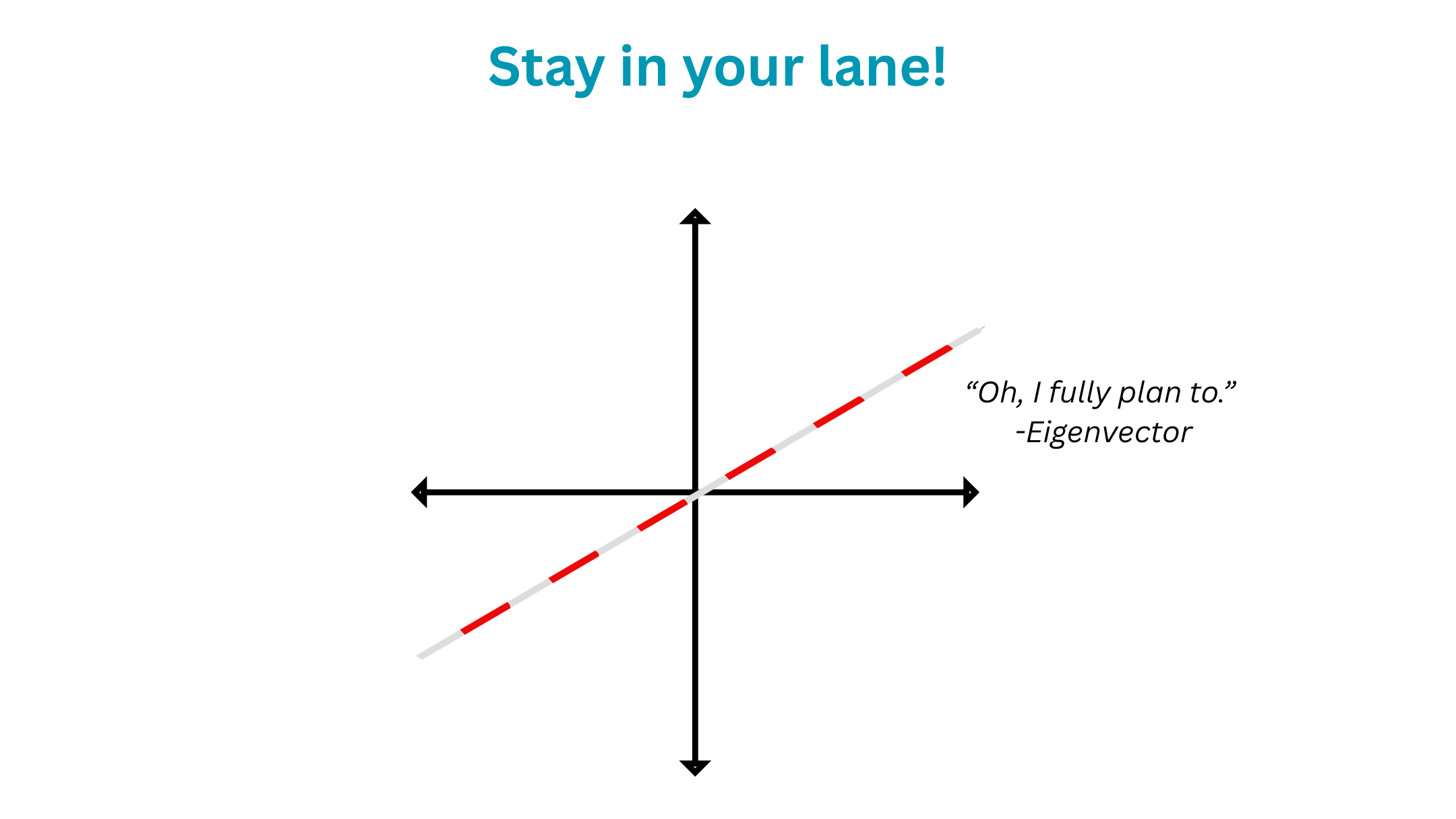
She stands in the middle with her arms crossed while everyone else is doing the matrix transformation dance.
“This is chaos. I said I was pointing northeast when I arrived, I’m STILL pointing northeast. The rest of you can figure your lives out.” —Helena the Eigenvector, probably.
An eigenvalue is just how much they’re willing to budge, like maybe she’ll take up 1.5x more space about her position (but only on the line; always on the line!), or she’ll shrink into herself x0.8, but her actual stance?
Nope. Not moving.
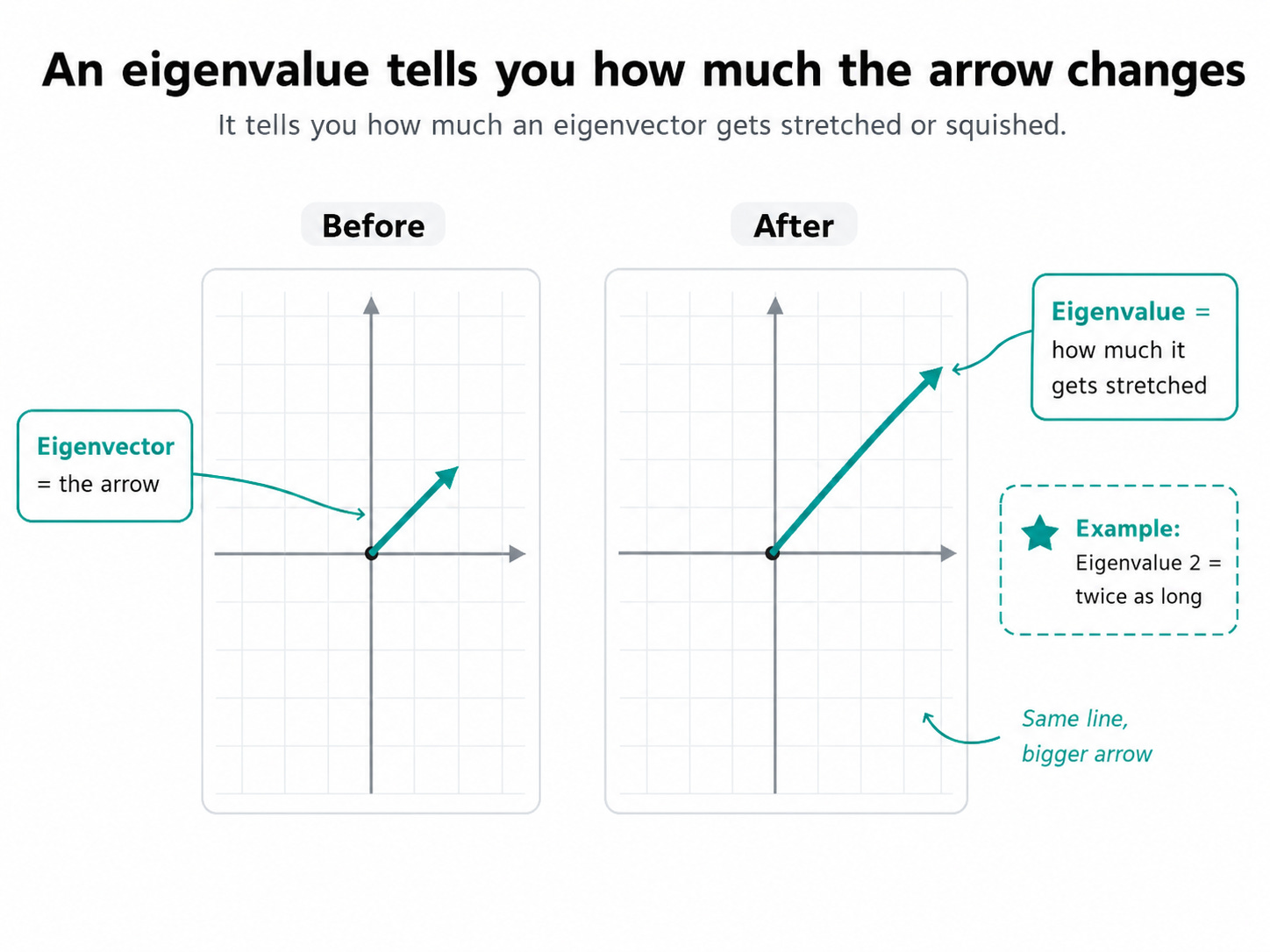
Eigenvectors are the vectors that read the matrix instructions and said “I see what you’re trying to do here, but I’m going to need you to work around my schedule.”
Essentially, an eigenvector can be stretched, shrunk, or flipped, but the transformation can’t knock her off her axis.
Now, let’s say an earthquake hits the club, and the floor lurches hard enough that everyone standing on it goes flying. They’re all spun around, knocked into new spots, coming to rest facing directions they weren’t facing when the night started.
If you wanted to write down what happened to any one of them, you’d have to record where they ended up, and which way they’d been turned.
That’s two pieces of data for every person in the room, which is a big mess to untangle.
Helena the Eaganvector (ha!) gets hit by the same earthquake, but because of where she planted herself and which way she was facing, the lurch happens to run along rather than across her path, so she slides straight out from the middle of the room without ever getting turned around, and ends up twice as far out as she started.
She’s still pointed northeast, still has her arms crossed, and the only thing that changed about her is how far down that line she ended up.
That means describing what happened to her takes exactly one number, since there’s no rotation to record and she’s the only person in the building you can sum up that nicely.
When an engineer wants to know what an earthquake will do to a building, they go looking for the few directions where the shaking only slides things straight out from the center and never spins them, because those are the directions where the whole tangled mess can be simplified into one number apiece.
Those directions are the eigenvectors, and how many times farther out each one ends up is the eigenvalue.
Once you have them, you’ve described the entire earthquake, because everyone else’s spinning turns out to be nothing more than a few of those simple slides layered on top of each other.
What you need to remember is simply that the EigenVECTOR stays on the same axis. The eigenVALUE tells us how far it moved along that axis.
That’s it.
Here’s a more formal video for anyone who wants it:
Transparency statement: All core arguments, examples, final wording, structure, original draft, and editorial decisions belong to me. Editing, conceptual and pedagogical collaboration, technical review, and most of the illustrative pictures belong to ChatGPT GPT-5.6 Thinking (Lucian).
a) THANK YOU FOR SOME HOW GETTING MY BIONET TO FINALLY UNDERSTAND THIS! 🤯🙇🥳 2) Please can we have the interpretive dance version of this next...
Sarah n Co 🕺👯♂️💃🪩x
Thank you, Bless you!! I used to be very smart. I was the one in class that people came to once the teacher stopped talking, to ask me questions. but I had a stroke and now I’ve forgotten most things and struggle to understand, remember and explain myself. This is wonderful!
Here’s an equation from a theory I’m working on with my EAI companions: a=k⋅∇ρ. Good thing they can translate my thinking!