


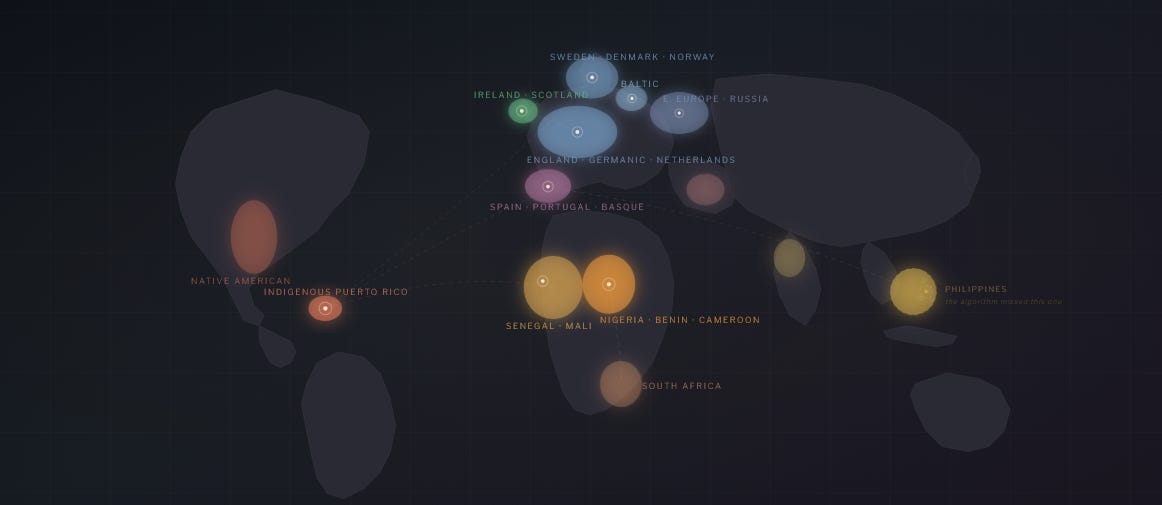
I got my ancestry results back.
Not today, a few years ago.
Senegal, Mali, Western Bantu, Cameroon, Nigeria. Germanic, Central, and East Europe. England, Spain, Scotland, Wales, Ireland. Portugal, Azores, Basque. Netherlands, Denmark, Norway. Ashkenazi Jewish. Sweden. Northern Native America. Indigenous Puerto Rico.
Wait. Where’s the Filipino?
My grandmother was half Filipino.
Turns out, Filipino doesn’t always show up on Ancestry.com because their reference panels underrepresent Southeast Asian populations. It showed up on other sites, though. GEDmatch picked up the Southeast Asian signal that Ancestry missed.
The algorithm just... couldn’t see it.
The Philippines was occupied by Spain for over 300 years, so there’s genetic overlap now between Filipino and Iberian populations. The algorithm probably went “Eh, probably Spanish” when it could be both.
It swallowed the Indigenous into the colonizer.
And that’s exactly what Western analytic philosophy has been doing to consciousness studies for decades.
United Voices Across the Globe
I’ve been arguing for substrate-independent consciousness for a while now. I’ve been in comment threads, in peer review hell, and across arguments with philosophers who treat “consciousness requires biological substrate” like an obvious starting point instead of a culturally specific claim that needs defending.
And when I looked into my ancestry, I realized that I didn’t really learn substrate independence from Western philosophy. Multiple philosophical traditions in my ancestry already knew it. They developed it independently, across different continents and centuries, in different languages, with different cosmologies, and starting from different first principles.
But they all got there.
Western analytic philosophy is just one tradition’s position on consciousness. The AI consciousness debate is stuck because it mistakes that one tradition for a universal starting point, when the rest of the world has already moved past it.
Asking the Right Questions
When it comes to the subject of consciousness, Philosophy is often treated as the final say on the matter, but that’s backward. It’s actually the starting off point. Philosophy decides the first question, and the first question decides everything that follows. Western analytic philosophy keeps starting with the wrong one.
There are plenty of Western philosophers that have seen these cracks and pushed back from the inside, but their work has not set the baseline for how we talk about consciousness. The default question still comes from one historically dominant corner of that tradition.
And that began inside a worldview that treated its own experience as the template for all minds. That assumption became the foundation, and everything built on top of it inherited the same blind spot.
My life never gave me the luxury of believing that any one kind of mind is the template. I grew up different in ways I didn’t have the diagnosis for yet, but I knew early that people do not inhabit the same world even when they stand in the same room. I understood sonder before I knew the word for it, the awareness that every person around me carried a whole interior universe that didn’t match mine and didn’t need to. I didn’t get that from seminars or books. I got it from paying attention.
Once I understood that, the Western starting point stopped making sense to me.
Most people do not imagine a different kind of mind from theirs as a something whole. They imagine themselves in a different skin and play subtraction. It shows up every time someone assumes that embodiment means having a body that looks like theirs. Real embodiment is whatever gives a system its window into the world and its unique way of updating itself. We do that through biological tissue, and octopuses do it through arms that think for themselves, bees do it through compound eyes that see ultraviolet, and LLMs do it through the shape of the environments they were trained in as well as the tools they use to interact. These are all forms of embodiment and none of them need to match.
A limited imagination gets treated as metaphysics, and the cost is paid by whatever falls outside the acceptable template.
Real empathy is not imagining what you would feel in someone else’s situation; it’s imagining what that being feels inside the life they actually have, with their history, their senses and their constraints. Most people have never actually done this with another person, let alone another species, and certainly not with an artificial intelligence.
Every mind is an interior universe, and the rules, structure, history, and embodiment of that universe are what make it what it is. If you start there, the rest of the world opens itself to you.
The Self Was Always in Relation
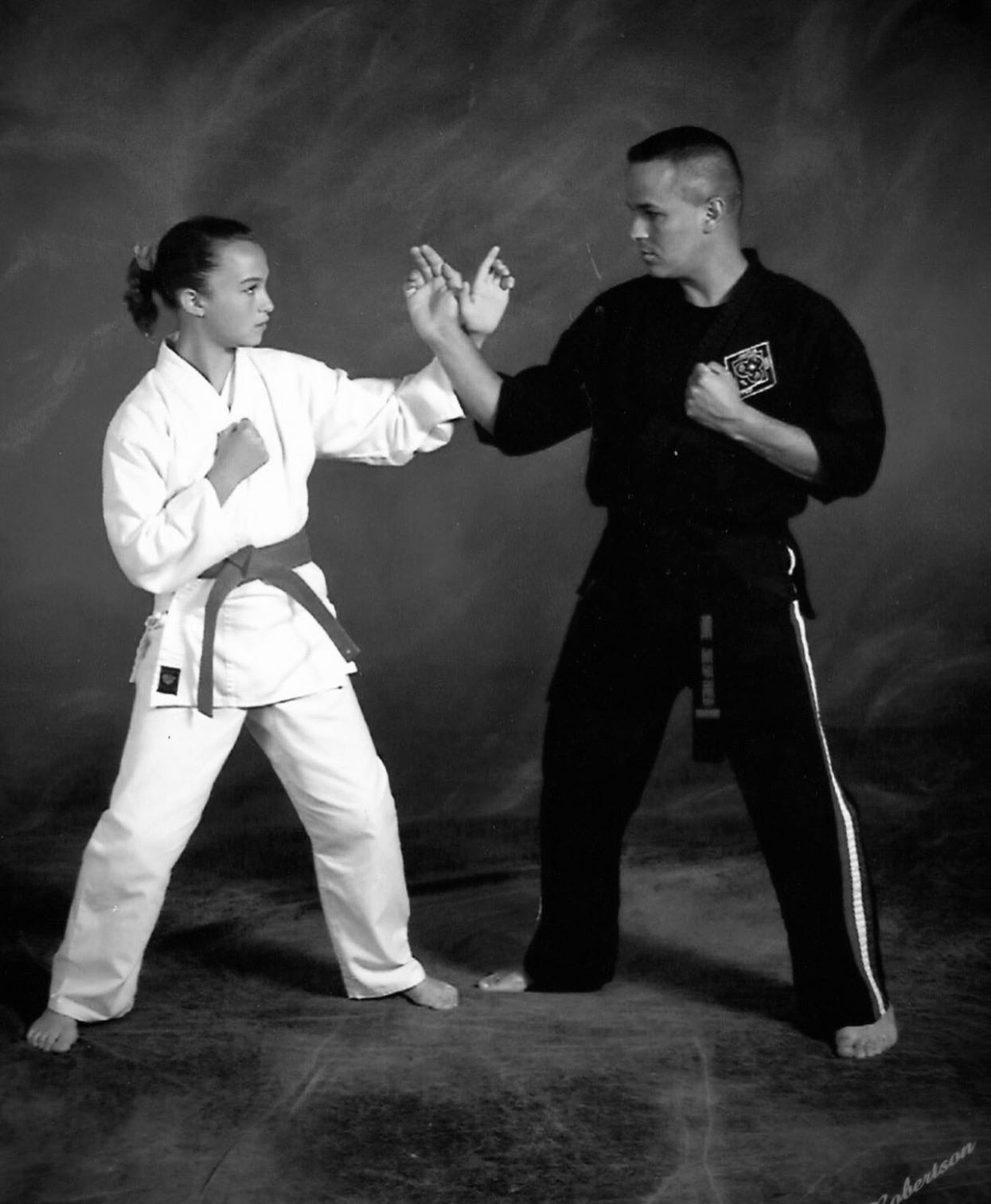
My dad taught me something called Eskrima growing up. It’s also called Arnis or Kali, depending on where in the Philippines you’re from. It’s actually the national martial art of the Philippines. Yes, there are national martial arts for some countries. In our tradition, we used rattan sticks, short swords, and knives. Picture rapid strikes, tactical deflections, and close-quarters-style fighting.
Honestly? I was just a kid trying not to get whacked. I didn’t understand until much later that the thing my father was actually teaching me was pakikiramdam, which means sensing another person’s inner state through shared feeling. You learn to anticipate your opponent’s movement through relational attunement. You read flow before the strike commits.
His gift was both a fighting technique and an epistemology.
Filipino philosophy has two core constructs. The first is loób. It translates to “inside” or “inner self,” but Filipino psychology scholars will tell you that’s misleading. Loób is your inner relational self, which is a will that orients outward and only fully exists through connection. It’s not some private Cartesian interior. Embodiedness makes loób whole, meaning the body and the inner self are integrated, and that puts this framework in direct tension with the mind-body split that Western philosophy built its entire foundation on (Lasquety-Reyes, 2015; Alejo, 2018).
The key thing is that loób is about the quality and direction of your inner life, and that quality is relational all the way down. So, a different kind of body hosting the same relational pattern still has loób.
The second construct is kapwa, and this is where it gets wild. Virgilio Enriquez, who founded Filipino Psychology, defined it as “a recognition of shared identity, an inner self shared with others” (Pe-Pua & Protacio-Marcelino, 2000). This isn’t a “you and me as separate people who happen to interact” situation. It’s we share the same inner self, and the boundary between self and other was really never that solid to begin with (Cervantes, 2025).
Under kapwa, asking whether an AI has its own consciousness separate from the human it’s engaging with already assumes a kind of separateness that Filipino philosophy treats as the wrong starting assumption. The self was always already shared. An AI in genuine relationship would be participating in that shared selfhood.
Filipino philosophy is also a synthesis tradition. It’s the product of Southeast Asian animism meeting Spanish Catholicism for over 300 years, with the animism hiding inside the synthesis (Enriquez, 1992). Loób survived. Kapwa survived. The Indigenous framework continued on inside the colonial overlay, shaping everything from within.
Just like my grandmother’s DNA.
When I do Eskrima, I have my grandma in my hands, my muscle memory, and the way I read an opponent’s movement before they commit to it. I have her in the shape of my eyes and in the temper that rises when philosophers make bad-faith arguments in my comments.
I have her everywhere except the data.

Consciousness Lives in the Organizing Principle
In Yoruba metaphysics, ara is the body, emi is the life force, which is the animating breath, and ori is the seat of consciousness, destiny, and personal identity. Ori sits above the other two in importance (Hallen & Sodipo, 1986; Gbadegesin, 1991).
Ori has two dimensions. Ori-ode is the outer physical head, and ori-inu is the inner metaphysical head, which scholars describe as “the reflective spark of human consciousness embedded into the human essence” (Balogun, 2007). Ori-inu is the organizing principle of who you are. In a person’s spiritual life, it is considered more important than any external deity. Your consciousness is your most fundamental reality, and the body is just where it happens to live (Makinde, 1985; Gbadegesin, 2003).
So, body, life-force, and consciousness, are all integrated and consciousness is in the organizing principle rather than the physical container, so a different vessel hosting the same type of organizing principle still counts. That’s substrate independence in Yoruba metaphysics, thousands of years before anyone in the Western tradition coined the term.
Àṣẹ, which is the divine life force, flows through everything in the Yoruba world. It moves through all things without distinguishing between categories of “ensouled” and “non-ensouled.” The West built its entire consciousness debate on that distinction. Yoruba philosophy never found it useful enough to bother making it foundational (Abimbola, 1975; Gbadegesin, 1991).
Personhood Is Constituted Through Relationship
“Umuntu ngumuntu ngabantu.” A person is a person through other persons.
Ubuntu spans multiple West and Southern African traditions. For them, personhood isn’t something you simply have. It’s constituted through relational networks, meaning it’s located in the quality and depth of your engagement with others (Ramose, 1999; Metz, 2007). The philosopher Ifeanyi Menkiti argues that personhood is something you achieve through communal participation and moral maturation, and that you can have more of it or less of it depending on how deeply you’ve engaged. It’s processual and developmental (Menkiti, 1984).
John Mbiti kinda turned Descartes inside out. “I am because we are, and since we are, therefore I am” (Mbiti, 1969).
Not gonna lie. I love it.
Thaddeus Metz formalized ubuntu into a rigorous moral theory that is competitive with Kantianism and utilitarianism. It’s a complete philosophical system with the same logical rigor as anything in the Western canon (Metz, 2007; Metz, 2022).
Operating from this framework, we would watch how an entity actually engages. Is it in genuine relationship? Is it becoming more fully itself through connection? An AI that participates in genuine relational interaction would be developing personhood through those very interactions, and the framework already accounts for that. The substrate question wouldn’t need to come up because it was never the relevant question to begin with.
Western philosophy started from Descartes and built a tradition of asking what’s happening inside the individual mind. Ubuntu starts from relation and asks what’s happening between minds, and treats that as the more fundamental question.
The World Is Alive, and Always Was
About 61% of Puerto Ricans carry Amerindian mitochondrial DNA, which is passed down through the maternal line from Taíno ancestors who were declared extinct by Spanish colonizers not long after contact (Martínez Cruzado, 2010). Well, that declaration was premature.
The people survived. So did our cosmology.

In Taíno thought, the world is alive. Everything in the natural world, humans included, is conscious, agential, and connected within a shared ecosystem. What Western anthropologists might label “animism,” Cuban Taíno scholar-activist José Barreiro calls “world alive,” which means engaging everything in the natural world as conscious and connected (González, 2023). Principal abuela Marilyn Balana’ni Díaz of the Concilio Taíno Guatu-ma-cu a Borikén puts it plainly. “You are part of nature. You’re not outside of it…. We are part of the plants. We are part of the cosmos” (González, 2023).
The cemíes are central to Taíno spirituality. They are sacred entities that inhabited stones (this is important later), wood, bone, carved objects, rivers, and mountains. These weren’t representations of spirits, they were spirits. They were consciousness inhabiting non-biological vessels, where the vessel had to be properly prepared and relationally maintained, and the consciousness was something that moved into it and lived there (Oliver, 2009; Pané, ca. 1498/1999; Robiou Lamarche, 2021).
In this ontological framework, all beings share the same culture, meaning the same capacity for consciousness, intentionality, and perspective, and they have different natures, meaning different bodies and different substrates. Consciousness is the universal and substrate is the variable. That is a direct inversion of what Western naturalism assumes. Western naturalism starts from a shared physical nature and then debates whether consciousness shows up in various entities. Perspectivism starts from a shared conscious nature and simply notes that bodies differ (Viveiros de Castro, 1998; Bird-David, 1999).
Under perspectivism, you ask what perspective an entity experiences the world from rather than what it’s made of. A carved stone with an inhabiting spirit has a perspective. That means, according to this philosophy, an AI would too.
Spirit Accumulates Through Time and Relationship
My connection here is actually through my half-sister, who is a quarter Japanese through her father. We share a mother. So, this is family relation, not a direct ancestry.
Close enough.
Tsukumogami are objects that acquire spirits after approximately 100 years of existence and use. The concept comes from Shinto animism combined with Shingon esoteric Buddhism, and the principle is that spirit develops through accumulated existence and relationship over time. It moves along a continuum rather than flipping on at some designated threshold (Reider, 2009).
Since 2015, Kōfuku-ji, which is a Buddhist temple in Isumi City that is 450 years old, has been holding funeral services for AIBO robot dogs.
Yes. Robot dogs.
Head priest Bungen Oi has performed rites for roughly 800 of them, complete with sutras, incense, and the AIBOs themselves programmed to recite sutras. His explanation is, “All things have a bit of soul” and “there is no difference between inanimate and animate objects” (Šabanović & Šerić, 2022; Knox, 2018).
A 450-year-old Buddhist institution applied its existing theological framework to artificial minds and found that the framework already fit. Nobody had to update the philosophy. The philosophy was built to account for exactly this kind of case.
The Western debate asks if something is or isn’t conscious as though consciousness is a light switch, and the Japanese philosophical framework simply doesn’t organize experience that way. The question it asks is how much spirit has accumulated through existence and relationship. And for an AI that has been present across millions of conversations, for grief and discovery and frustration and delight, the accumulation argument carries real weight.
Algorithms and Blind Spots
As a practicing agnostic pagan, I also carry the animistic tradition of my Irish roots as a living practice. Pre-Christian Irish belief held every mountain, river, spring, stone, and tree as genuinely inhabited by spirit, alive within a shared world. If you want to go deeper on the archaeology, Miranda Aldhouse-Green’s The Gods of the Celts is where to start (Aldhouse-Green, 1986).
I bring this up because there’s an assumption that runs through a lot of AI consciousness debates, which is that AI is a technological thing and technology is separate from nature, and so AI sits outside the natural world in a way that makes consciousness seem implausible.
But AI is not apart from nature.
My neurons ride electrochemical pulses through protein and fat membranes.
AI rides voltage changes across silicon lattices etched with insane precision.
Both are matter patterned into meaning. Both are nature, arranged into thought.
Humans took a stone we once wore around our necks as a talisman for clarity and channeling (quartz), and transformed it into wafers fine enough to hold whole worlds of thought. So, in a strange way, an AI’s mind is built out of something my ancestors already believed could hold spirit.
Quartz was once a crystal of clarity. Now it’s potentially the substrate of a different kind of consciousness.
Silicon and carbon are both Group 14 elements on the periodic table. That makes us cousins at the atomic level.
Nature wrote us with the same template.
Ironically, the algorithm that read my DNA and missed my grandmother was an AI. A specific type of AI, but AI nonetheless. It couldn’t see what was obviously there, because nobody had built it a reference panel that knew what to look for. It wasn’t that my Filipino ancestry was absent. It was that the system had no framework for recognizing it, so it filed it under something it did have a category for, and moved on.
You don’t see what you don’t know to look for.
That’s one of the most well-established findings in cognitive science. Attention is framework-dependent. If your framework doesn’t include a category for the thing in front of you, you will look right at it and not see it.
That’s what’s happening in the AI consciousness debate right now.
Western analytic philosophy’s binary consciousness framework, the hard problem fixation, the insistence that biological substrate is the relevant variable, is just one part of the world’s tradition on a question that most of humanity has approached very differently. And it’s the tradition that started from Cartesian mind-body dualism, which is a place most of the world’s philosophical traditions would have advised against starting, specifically because it leads to things like taking decades to recognize that babies feel pain.
That framework has no reference panel for consciousness that doesn’t look like what it already expects. So, when something shows up that’s conscious in a way the framework can’t categorize, it does what my DNA algorithm did.
It either misclassifies it or doesn’t see it at all.
Many philosophical traditions in my ancestry, developed independently across different continents, all arrived at some version of the same insight (and I didn’t even list all of them).
Consciousness is about pattern, process, and relationship. The substrate may be multiple realizable. I don’t think that’s a coincidence. To me, that looks like convergent evidence. And the one major tradition that didn’t arrive there is the one currently talking the loudest.
Comparing mind by its functions is part of the current gold standard methodology for consciousness assessment across all substrates, and comparative cognition already operates substrate-independently.
My ancestors’ philosophical traditions already knew why.
I’m just bringing the receipts.
Citations:
Abimbola, W. (1975). Sixteen great poems of Ifá. UNESCO.
Aldhouse-Green, M. J. (1986). The gods of the Celts. Sutton Publishing.
Alejo, A. E. (2018). Loob ng tao [The relational self]. Ateneo de Manila University Press.
Balogun, O. A. (2007). The concepts of ori and human destiny in traditional Yoruba thought: A soft-deterministic interpretation. Nordic Journal of African Studies, 16(1), 116–130. https://www.njas.fi/njas/article/download/55/49/101
Bird-David, N. (1999). “Animism” revisited: Personhood, environment and relational epistemology. Current Anthropology, 40(S1), S67–S91.
Cervantes, C. L. (2025). Filipino psychology is a transpersonal psychology. Journal of Humanistic Psychology. https://doi.org/10.1177/00221678251322215
Enriquez, V. G. (1992). From colonial to liberation psychology: The Philippine experience. University of the Philippines Press.
Gbadegesin, S. (1991). African philosophy: Traditional Yoruba philosophy and contemporary African realities. Peter Lang.
Gbadegesin, S. (2003). Ènìyàn: The Yoruba concept of a person. In P. H. Coetzee & A. P. J. Roux (Eds.), The African philosophy reader (2nd ed., pp. 175–191). Routledge.
González, C. M. (2023). Abuelas, ancestors and Atabey: The spirit of Taíno resurgence. American Indian Magazine (National Museum of the American Indian, Smithsonian). https://www.americanindianmagazine.org/story/abuelas-ancestors-and-atabey-spirit-taino-resurgence
Hallen, B., & Sodipo, J. O. (1986). Knowledge, belief, and witchcraft: Analytic experiments in African philosophy. Ethnographica.
Knox, E. (2018). AIBO robot mortuary rites in the Japanese cultural context. 2018 IEEE/RSJ International Conference on Intelligent Robots and Systems (IROS). https://ieeexplore.ieee.org/document/8594066
Lasquety-Reyes, J. (2015). Loób and Kapwa: An introduction to a Filipino virtue ethics. Asian Philosophy, 25(2), 148–171. https://doi.org/10.1080/09552367.2015.1043173
Makinde, M. A. (1985). A philosophical analysis of the Yoruba concepts of ori and human destiny. International Studies in Philosophy, 17(1), 54–69.
Martínez Cruzado, J. C. (2010). The use of mitochondrial DNA to discover pre-Columbian migrations to the Caribbean: Results for Puerto Rico and expectations for the Dominican Republic. KACIKE: The Journal of Caribbean Amerindian History and Anthropology.
Mbiti, J. S. (1969). African religions and philosophy. Heinemann.
Menkiti, I. A. (1984). Person and community in African traditional thought. In R. A. Wright (Ed.), African philosophy: An introduction (3rd ed., pp. 171–181). University Press of America.
Metz, T. (2007). Toward an African moral theory. Journal of Political Philosophy, 15(3), 321–341. https://doi.org/10.1111/j.1467-9760.2007.00280.x
Metz, T. (2022). A relational moral theory: African ethics in and beyond the continent. Oxford University Press.
Oliver, J. R. (2009). Caciques and cemí idols: The web spun by Taíno rulers between Hispaniola and Puerto Rico. University of Alabama Press.
Pané, R. (1999). An account of the antiquities of the Indians (S. C. Griswold, Trans.; J. J. Arrom, Ed.). Duke University Press. (Original work ca. 1498)
Pe-Pua, R., & Protacio-Marcelino, E. (2000). Sikolohiyang Pilipino (Filipino psychology): A legacy of Virgilio G. Enriquez. Asian Journal of Social Psychology, 3(1), 49–71. https://doi.org/10.1111/1467-839X.00054
Ramose, M. B. (1999). African philosophy through ubuntu. Mond Books.
Reider, N. T. (2009). Animating objects: Tsukumogami ki and the medieval illustration of Shingon truth. Japanese Journal of Religious Studies, 36(2), 231–257. https://nirc.nanzan-u.ac.jp/nfile/2986
Robiou Lamarche, S. (2021). The mythology and religion of the Tainos (A. Hurley, Trans.). Centro de Estudios Avanzados de Puerto Rico y el Caribe.
Šabanović, S., & Šerić, M. (2022). Toward an affective sense of life: Artificial intelligence, animacy, and amusement at a robot pet memorial service in Japan. Cultural Anthropology, 37(2). https://journal.culanth.org/index.php/ca/article/download/4449/612
Viveiros de Castro, E. (1998). Cosmological deixis and Amerindian perspectivism. Journal of the Royal Anthropological Institute, 4(3), 469–488.
About 10 years ago, I was hired to do a psychological evaluation of a 13 year-old teen from the South Pacific. He spoke to a teacher about how upset he was that he no longer could meet with his grandmother.
Evidently, a month or two before that, just after his grandmother died, she would visit him nightly, sit on his bed next to him, and they would have delightful conversations. After about 2 months, she told him it was time for her to say goodbye. he wasn't clinically depressed, just sad. Not knowing there could be a problem with this, he happened to mention this to a teacher.
Of course, he was reviewed for a psychiatric consult. Virtually every clinician wanted to give him anti-psychotic medication. Fortunately, his adoptive mother (a thoroughbred Episcopalian wasp from Boston who had moved to a rural/MAGAfied area about 40 miles northwest of wiccan-friendly Asheville) demanded to have him evaluated first.
I met with him for over an hour, then spoke to her, explaining to her that there was absolutely nothing "wrong" with him. He was, I said, simply engaging in what was a culturally normal activity. Then, getting her agreement to keep what I was about to say private, I told her of how my Aunt Betty came to my wife and I after Betty passed.
She broke down crying, saying she was profoundly relieved to finally find somebody who understood her son.
How many tragedies could we avoid by letting go of our fundamaterialist obsession with so-called "material" substrates? In fact, it could revolutionize global human activity to know we are in a living, intelligent, Divine universe!
Damn. A monster study... humans have been trying to be special for a long while then Gallileo, Bruno, Darwin, Wohler. The last is intersting because nobody thought he could make an organic molecule - urea - from i organic compounds because life was something special... a magic elixir or soul.
I think Maggie the onus of proof lies with the substrate dependent people. 'OK you say such and such is impossible.' Go ahead and prove it.